
Why Do IGET Product Packages Have Different Designs?
Have you ever noticed that two IGET products can have surprisingly different packaging?
One box might feature a black-and-gold design, while another uses colourful graphics. Some packages have QR codes, while others feature orange security labels.
For Australian consumers researching IGET packaging differences, these variations can raise an important question:
Does different packaging mean the product is fake?
Not necessarily.
IGET has introduced different product series and officially recognises multiple anti-counterfeiting authentication formats.
However, packaging differences should not automatically be accepted as legitimate, either.
Understanding the distinction between packaging design, product identification and official verification is essential.
1. Different IGET Models Have Different Packaging
The first thing to establish is whether two packages actually contain the same product model.
IGET ONE 12000 and IGET BAR PRO 10000, for example, belong to different product series.
They have different exterior designs, technical specifications and model identities.
As a result, comparing their packaging without checking the model names can be misleading.
FeatureIGET ONE 12000IGET BAR PRO 10000Product seriesIGET ONEIGET BAR PROAdvertised puff countUp to 12,000 in Regular ModeUp to 10,000Published battery capacity2700mAh2000mAhPublished heating element0.6Ω Dual Mesh1.2Ω MeshExterior styleGold-and-black design with displayCompact device with graphic front panelDifferent packaging for different models is not unusual.
The more useful comparison is between two packages claiming to contain the exact same model and variant.
<text color="secondary" italic>Suggested image placement: SEO main image — Why Do IGET Product Packages Have Different Designs?</text>
2. IGET Has Officially Documented Different Security Codes
An important difference between IGET packaging versions involves its authentication system.
On 1 April 2025, IGET published an announcement describing its dual anti-counterfeiting authentication approach.
The company identifies two formats:
A newer orange image-based security code.
An older QR-code-based verification system.
The official authentication page also acknowledges that different packaging versions exist.
This provides a documented explanation for why two IGET packages may use different security labels.
However, the existence of two legitimate verification methods does not mean that every package displaying either code is genuine.
Counterfeit packaging may imitate legitimate security features.
3. Orange Security Code vs Traditional QR Code
The distinction between these authentication formats is worth understanding.
Newer Orange Image Code
IGET describes a newer system using an orange anti-counterfeiting image on the packaging.
Its official verification page offers an image-based process for checking this code.
The purpose is to provide an additional method of assessing product authenticity.
Older QR Code
Older packaging may include a security QR code.
IGET provides a separate QR-based verification option.
However, it is important to distinguish an ordinary QR code from an official manufacturer verification result.
A QR code can contain a website address or other information. Scanning one does not automatically prove that the product is genuine.
Comparison
Verification FeatureOrange Image CodeQR CodeDocumented by IGETYesYesOfficial verification methodImage-based verificationQR-based verificationAssociated packagingNewer formatOlder formatCan appearance alone prove authenticity?NoNoOfficial verification requiredYesYesBoth methods should be assessed through IGET's official authentication service.
Official verification website:
<text color="secondary" italic>Suggested image placement: Content Image 1 — IGET Packaging Verification Guide: QR Code vs Orange Security Code.</text>
4. Why Packaging Colours and Graphics May Differ
Product packaging is more than a protective box.
It identifies the product and communicates information about the model.
Possible reasons for differences in packaging artwork include:
Different product series: IGET ONE and IGET BAR PRO have separate product identities.
Different product variants: Packaging may identify a specific version or variant.
Packaging revisions: Manufacturers sometimes change printing layouts, typography or security features.
Different reference images: Online product images may depict different packaging versions or may be outdated.
Incorrect or counterfeit packaging: Not every difference has a legitimate explanation.
An important limitation is that IGET has not published a complete, independently verified history of every packaging design for every model.
Therefore, a particular colour change or box design should not automatically be described as an official update without supporting evidence.
5. What Information Should You Compare on IGET Packaging?
When assessing packaging differences, the most useful information is often found outside the main product artwork.
Rather than relying only on colour and appearance, compare the following details.
Exact Model Name
Check whether the package identifies IGET ONE, IGET BAR PRO or another series.
A different model name may explain differences in printed specifications and packaging design.
Technical Specifications
Look for information such as battery capacity, heating element specifications and advertised puff count.
If the packaging lists specifications that differ from reliable manufacturer documentation for the same model, the discrepancy deserves further investigation.
Manufacturer or Company Information
Some packaging may contain a company name, contact details or an address.
These details should be interpreted carefully.
A brand owner, manufacturer, importer and distributor can be different legal entities.
The appearance of a company name does not independently prove where a product was manufactured.
Security Verification Information
Look for the relevant verification format and confirm that the website being used belongs to the legitimate manufacturer.
Batch or Lot Information
A batch or lot number, when present, may help identify a production group for traceability purposes.
However, a batch number alone is not proof of authenticity.
The information must be interpreted alongside reliable manufacturer records.
<text color="secondary" italic>Suggested image placement: Content Image 2 — What Should You Check on IGET Packaging?</text>
6. Does a Different Box Mean a Counterfeit Product?
Not necessarily.
Packaging differences and counterfeit indicators should not be treated as identical concepts.
Consider three situations.
Situation A: Different models
One package contains an IGET ONE, while the other contains an IGET BAR PRO.
Different designs are expected because the products are different.
Situation B: Different authentication formats
Two packages use different security codes, one orange and one QR-based.
IGET has documented both verification methods, so the difference itself is not sufficient evidence of counterfeiting.
Situation C: Conflicting product information
Two packages claim to contain the same model but show significantly different specifications, company details or verification destinations.
Such discrepancies require independent confirmation.
They may indicate a legitimate revision, inaccurate printing or potentially counterfeit packaging.
The key principle is simple:
Different packaging is an observation, not a final authenticity verdict.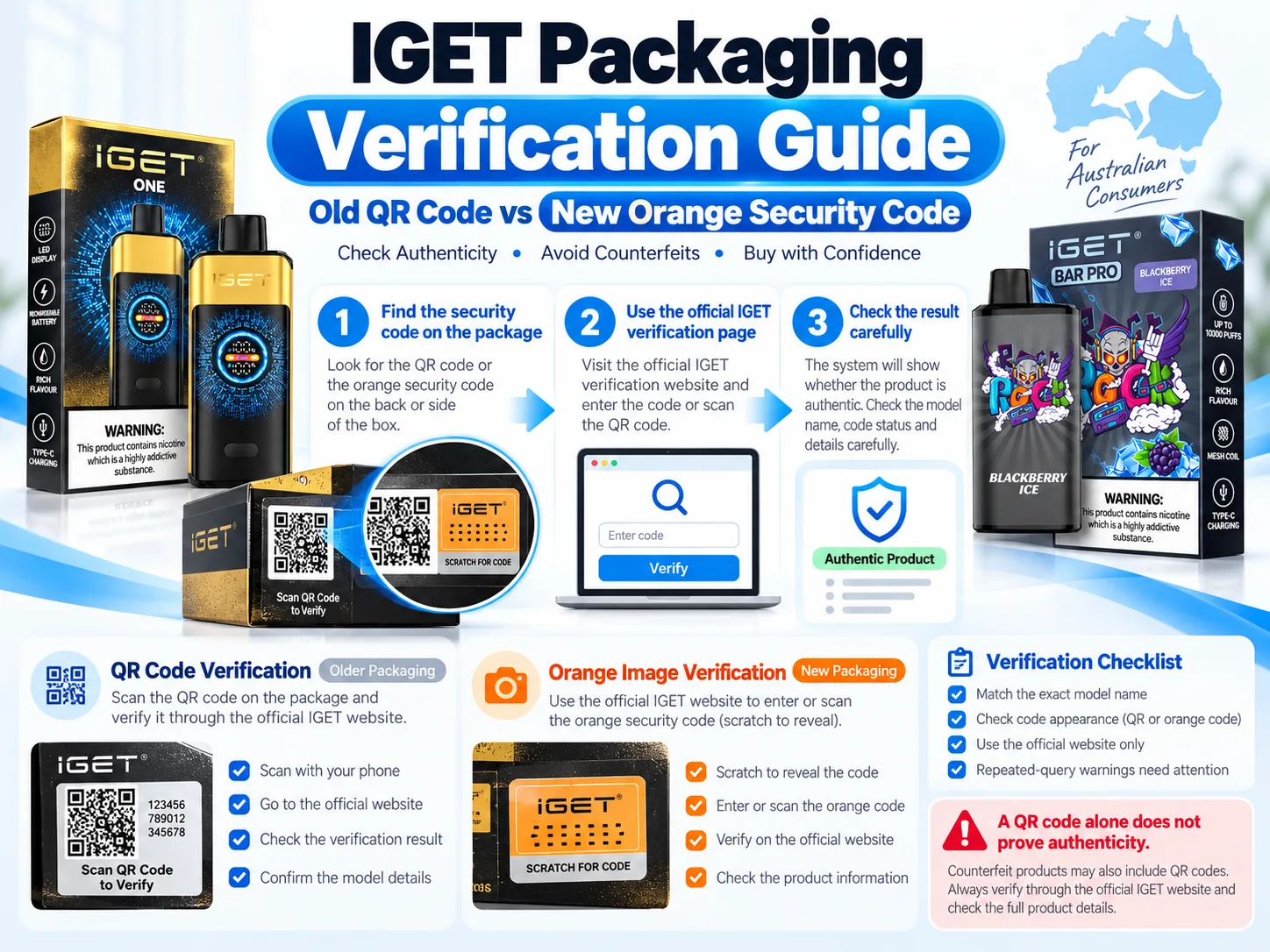
7. Can Counterfeit IGET Products Copy Official Packaging?
Yes.
Packaging artwork, logos and QR codes can be reproduced or imitated.
This is why visual similarity is not a reliable standalone authentication method.
IGET's verification service includes information about repeated security-code queries.
A code that has been checked repeatedly may require additional investigation.
However, consumers should avoid treating an isolated visual detail as conclusive.
When a verification result is suspicious or inconsistent, the appropriate response is to consult the official manufacturer's published support channels.
Avoid relying on unfamiliar websites claiming to provide independent IGET authentication.
8. What Does Australian Law Say About Vape Packaging?
Australia has specific requirements for permitted therapeutic vaping products.
These requirements differ significantly from the colourful commercial packaging commonly seen in overseas product catalogues.
Under Australia's therapeutic vaping framework, relevant goods are subject to packaging, labelling and product-presentation standards.
For example, applicable standards restrict promotional designs and require specified information and warnings.
The precise requirements depend on whether the item is a vaping substance, device, accessory or therapeutic vaping pack.
Therefore, packaging that appears in an overseas IGET catalogue should not automatically be assumed to satisfy Australian requirements.
More importantly, Australia prohibits the commercial supply of single-use disposable vaping devices.
An authentic overseas product is not necessarily eligible for lawful supply in Australia.
Authenticity vs Legal Compliance
These are two different questions:
Authenticity: Was the product genuinely made or authorised by the claimed manufacturer?
Australian compliance: Does the product meet the legal requirements for its type and proposed supply?
A product may be authentic without complying with Australian law.
Likewise, a package displaying Australian information does not independently prove lawful supply.
9. Why Does This Matter for Australian Consumers?
A packaging comparison can reveal useful information, but it has limits.
Colour schemes, security-code styles and artwork may help identify differences between versions.
They do not establish product origin on their own.
Australian consumers should pay particular attention to the exact model identity, reliable manufacturer information and the applicable Australian regulatory framework.
A website describing a product as Australian stock does not independently verify either authenticity or legal compliance.
For technical product identification, manufacturer documentation is useful.
For legal questions, the Therapeutic Goods Administration provides the relevant Australian guidance.
Conclusion
IGET product packages may have different designs for several reasons, including differences between product series, changes to packaging artwork and officially documented authentication formats.
IGET has confirmed that both orange image-based security codes and QR-based verification methods exist.
That fact explains some packaging differences, but it does not establish that every package displaying those features is genuine.
A more reliable assessment considers the exact model, technical specifications, manufacturer information and official authentication results.
For Australian readers, there is an additional consideration: genuine packaging and legal compliance are not the same thing.
Understanding these distinctions helps consumers interpret packaging differences without making unsupported assumptions about authenticity.