
Why Do IGET Product Packages Have Different Designs?
Two IGET boxes can look surprisingly different from each other. One uses a black-and-gold design, another goes with colourful graphics. Some carry QR codes, others have orange security labels.
For Australian customers researching IGET packaging differences, that raises an obvious question: does different packaging mean the product is fake?
Not necessarily. IGET sells several product series and officially recognises more than one anti-counterfeiting authentication format.
That said, a packaging difference should not be waved through as legitimate just because an explanation exists. The distinction between packaging design, product identification and official verification is the whole game here.
1. Different IGET Models Have Different Packaging
First, work out whether the two packages even claim to hold the same model. The IGET ONE 12000 and the IGET BAR PRO 10000 belong to different series, with different exteriors, specifications and model identities. Comparing their boxes without checking the model names will only confuse you.
| Feature | IGET ONE 12000 | IGET BAR PRO 10000 |
|---|---|---|
| Product series | IGET ONE | IGET BAR PRO |
| Advertised puff count | Up to 12,000 in Regular Mode | Up to 10,000 |
| Published battery capacity | 2700mAh | 2000mAh |
| Published heating element | 0.6Ω Dual Mesh | 1.2Ω Mesh |
| Exterior style | Gold-and-black design with display | Compact device with graphic front panel |
Different packaging for different models is normal. The useful comparison is between two boxes claiming to hold the exact same model and variant.
2. IGET Has Officially Documented Different Security Codes
The biggest documented reason for packaging differences is the authentication system itself.
On 1 April 2025, IGET published an announcement describing its dual anti-counterfeiting approach. The company identifies two formats:
- A newer orange image-based security code.
- An older QR-code-based verification system.
The official authentication page also acknowledges that different packaging versions exist, which gives a documented explanation for why two boxes may carry different security labels.
But two legitimate verification methods do not mean every package showing either code is genuine. Counterfeit packaging can imitate legitimate security features.
3. Orange Security Code vs Traditional QR Code
The two formats are worth telling apart.
Newer orange image code
IGET describes a newer system using an orange anti-counterfeiting image on the packaging. Its official verification page offers an image-based process for checking that code. The purpose is to add another way of assessing authenticity.
Older QR code
Older packaging may carry a security QR code, with a separate QR-based verification option from IGET.
One caution here: an ordinary QR code is not the same thing as an official verification result. A QR code can hold any website address. Scanning one proves nothing on its own.
Comparison
| Verification Feature | Orange Image Code | QR Code |
|---|---|---|
| Documented by IGET | Yes | Yes |
| Official verification method | Image-based verification | QR-based verification |
| Associated packaging | Newer format | Older format |
| Can appearance alone prove authenticity? | No | No |
| Official verification required | Yes | Yes |
Both methods should be assessed through IGET's official authentication service – not through whatever site the code happens to point at.
Official verification website: use the manufacturer's own published authentication page.
4. Why Packaging Colours and Graphics May Differ
Packaging does more than protect the box in transit. It identifies the product and communicates the model. Legitimate reasons for artwork differences include:
Different product series: IGET ONE and IGET BAR PRO have separate product identities.
Different variants: packaging may identify a specific version.
Packaging revisions: manufacturers change printing layouts, typography and security features over time.
Different reference images: online product photos can show older packaging versions.
Incorrect or counterfeit packaging: not every difference has a benign explanation.
One important limit: IGET has not published a complete, independently verified history of every packaging design for every model. So a particular colour change should not be described as an "official update" without evidence.
5. What Should You Compare on IGET Packaging?
The most useful information usually sits outside the main artwork. Rather than judging by colour, compare these details.
Exact model name
Check whether the package identifies IGET ONE, IGET BAR PRO or another series. A different model name often explains differences in printed specs and design.
Technical specifications
Look for battery capacity, heating element details and advertised puff count. If the box lists specs that clash with reliable manufacturer documentation for the same model, investigate further.
Manufacturer or company information
Some boxes carry a company name, contact details or address. Read these carefully – a brand owner, manufacturer, importer and distributor can be four different legal entities. A company name on the box does not prove where the product was made.
Security verification information
Find the verification format and confirm the website you would use belongs to the legitimate manufacturer.
Batch or lot information
A batch number, when present, may help identify a production group for traceability. It is not proof of authenticity and should be read alongside reliable manufacturer records.
6. Does a Different Box Mean a Counterfeit Product?
Not necessarily. Packaging differences and counterfeit indicators are not the same concept. Three situations cover most cases:
Situation A: different models. One box holds an IGET ONE, the other an IGET BAR PRO. Different designs are expected because the products are different.
Situation B: different authentication formats. Two boxes use different security codes – one orange, one QR-based. IGET has documented both methods, so the difference alone is not evidence of counterfeiting.
Situation C: conflicting product information. Two boxes claim the same model but show significantly different specifications, company details or verification destinations. That needs independent confirmation – it may be a legitimate revision, a printing error, or counterfeit packaging.
The key principle: different packaging is an observation, not a final authenticity verdict.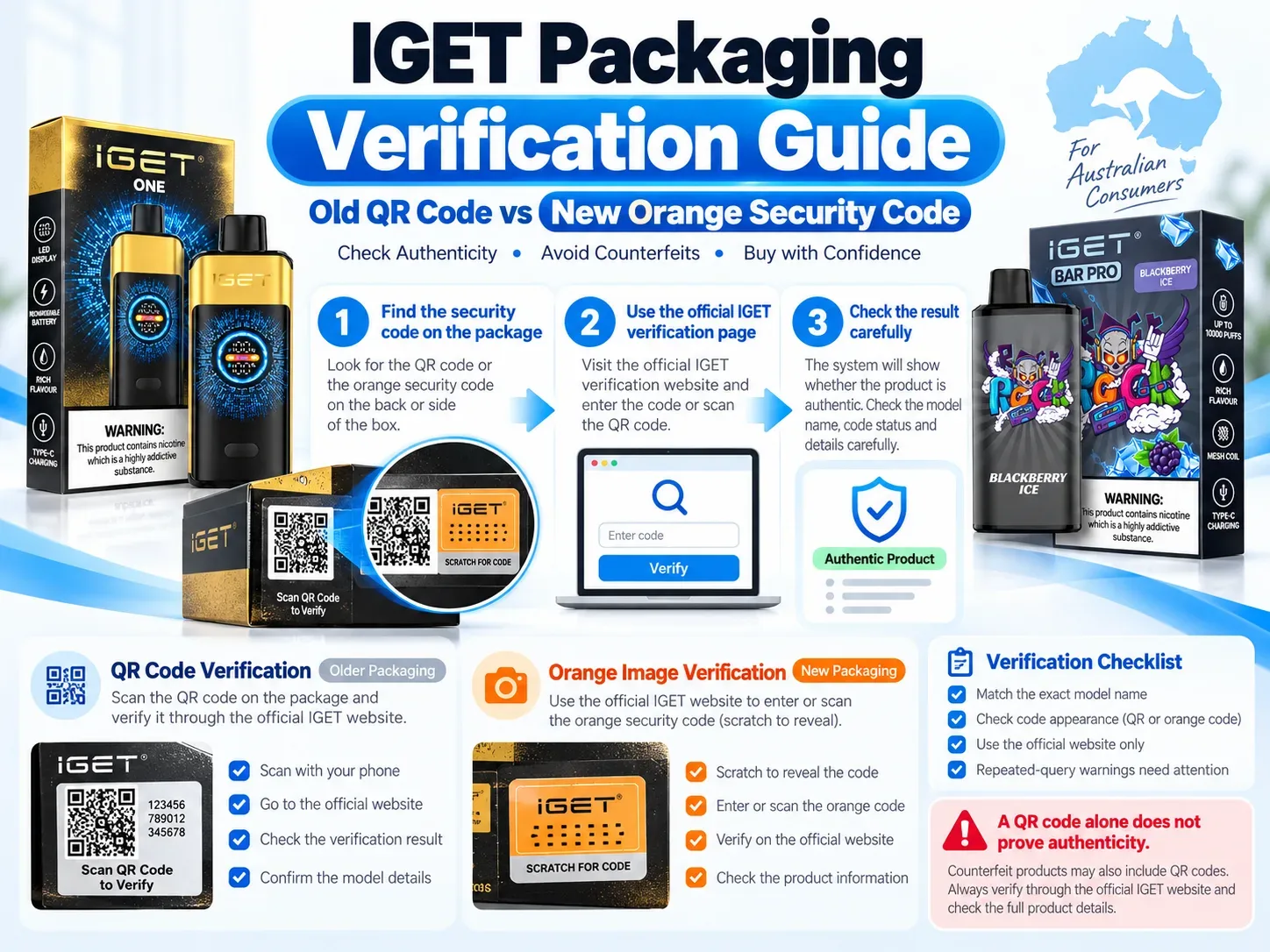
7. Can Counterfeit IGET Products Copy Official Packaging?
Yes. Artwork, logos and QR codes can all be reproduced.
This is why visual similarity is not a reliable standalone authentication method. IGET's verification service includes information about repeated security-code queries – a code that has been checked many times may need further investigation.
Even so, avoid treating one visual detail as conclusive. If a verification result looks suspicious or inconsistent, go through the manufacturer's published support channels. And skip the unfamiliar websites claiming to offer "independent IGET authentication" – we have seen a few of those floating around in customer emails.
8. What Does Australian Law Say About Vape Packaging?
Australia has specific requirements for permitted therapeutic vaping products, and they differ sharply from the colourful commercial packaging common in overseas catalogues.
Under the therapeutic vaping framework, relevant goods are subject to packaging, labelling and product-presentation standards. Applicable standards restrict promotional designs and require specified information and warnings. The exact requirements depend on whether the item is a vaping substance, device, accessory or therapeutic vaping pack.
So packaging from an overseas IGET catalogue should not be assumed to meet Australian requirements. More importantly, Australia prohibits the commercial supply of single-use disposable vaping devices. An authentic overseas product is not automatically eligible for lawful supply here.
Authenticity vs legal compliance
These are two separate questions:
- Authenticity: was the product genuinely made or authorised by the claimed manufacturer?
- Australian compliance: does the product meet the legal requirements for its type and proposed supply?
A product can be authentic without complying with Australian law. Likewise, a box printed with Australian-looking information does not prove lawful supply.
9. Why Does This Matter for Australian Consumers?
A packaging comparison can reveal useful information, but it has limits. Colours, security-code styles and artwork help you spot differences between versions. They do not establish product origin on their own.
Focus on the exact model identity, reliable manufacturer information and the applicable Australian regulatory framework. A website describing something as "Australian stock" verifies neither authenticity nor compliance by itself.
For product identification, use manufacturer documentation. For legal questions, the Therapeutic Goods Administration provides the relevant Australian guidance.
Conclusion
IGET packages differ for several documented reasons: different product series, packaging revisions, and two officially recognised authentication formats.
IGET has confirmed that both orange image-based codes and QR-based verification exist. That explains some differences, but it does not make every package displaying those features genuine.
The more reliable assessment weighs the exact model, the printed specifications, the manufacturer information and the official verification result together. And for Australian readers there is one more layer: genuine packaging and legal compliance are not the same thing.
Keep those distinctions separate and most packaging differences stop being alarming.